


Aberrant Neural Entrainment to Word-Level Speech Patterns in Fragile X Syndrome: Evidence for a Statistical Learning Deficit
Authors: Laura Batterink, Yanchen Liu, Grace Westerkamp, Jae Citarella, Peyton Siekierski, Lynxie Voorhees, Lauren E Ethridge, Elizabeth Smith, Rana Elmaghraby, Craig A Erickson, Zag ElSayed, Anubhuti Goel, Steve W Wu, and Ernest V Pedapati[1]
Read the article published in Autism Research
Talk Presented by: Jack Liu, Clinical Research Coordinator, Cincinnati Children’s Hospital Medical Center
Summarized by: Andrew Gaulden, Postdoctoral Researcher, Cincinnati Children’s Hospital Medical Center
Summary
Long before a child speaks a first word, the brain is quietly doing detective work. Speech does not arrive in tidy, separated words. It comes as a continuous stream of sound, and the listener has to discover where one word stops and the next begins.
Infants solve this by tracking which syllables reliably follow one another, a talent researchers call statistical learning: the ability to notice and predict patterns in the world by natural exposure. It is one of the earliest engines of language, and yet, remarkably, no one had ever tested how well it works in Fragile X syndrome, the most common inherited cause of intellectual disability. That was the question this study set out to answer.
The team designed an elegant test that asks nothing of the child except to listen. Each participant wore a sensor cap that records the brain’s natural electrical activity (an EEG, which is painless and completely non-invasive) while a twelve-minute recording of invented three-syllable words, such as “ta-fu-ko,” played in the background. Meanwhile, the child simply watched a silent video.
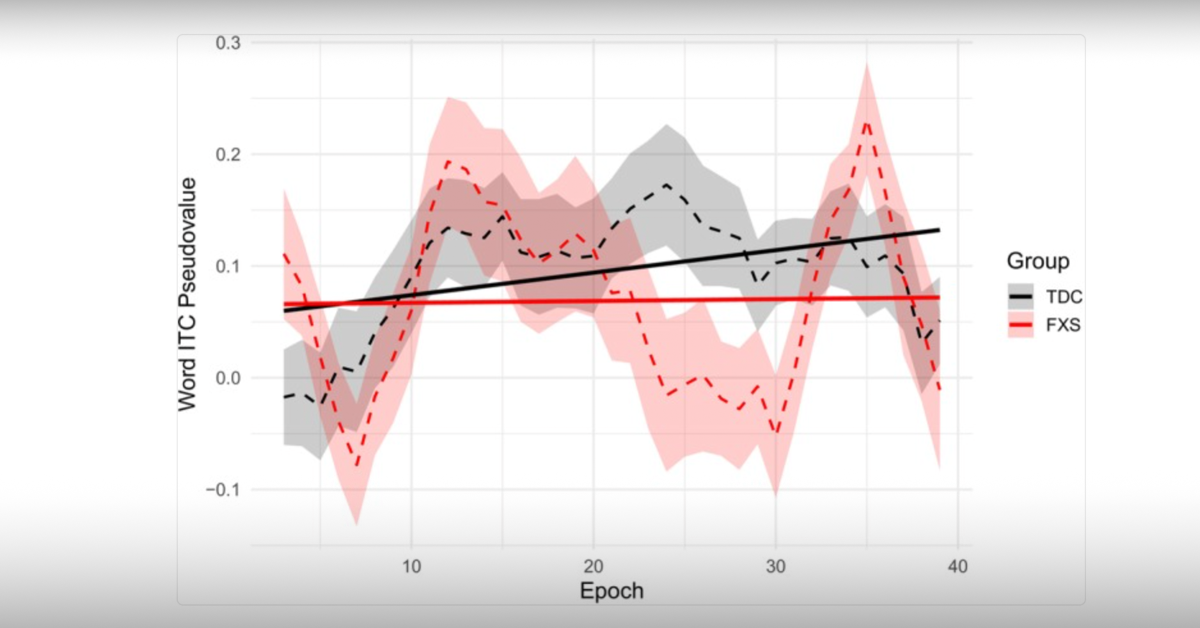
Using EEG, the researchers measure how the rhythm of brain activity matches up to the rhythm of the words. When the brain begins to recognize a repeating word, its activity starts to synchronize with the pace of that word, a phenomenon known as neural entrainment. Because the syllables arrived at one steady beat and the hidden words at a slower one, the researchers could watch, in real time, whether a child’s brain was merely hearing the sounds or actually stitching them into words. They compared 17 children with Fragile X syndrome to 31 typically developing peers.
The results drew a sharp and revealing line. Children with Fragile X tracked the individual syllables just as well as their peers, and in some measures even more strongly, proof that their hearing and basic sound processing were fully intact. But their brains did not lock onto the repeating words made of the syllables. When researchers examined brain differences between children with Fragile X syndrome and typically developing peers, they found a major difference in the auditory cortex, the brain’s primary hearing region.
Why This Matters
Language difficulty is among the most defining and most stubborn features of Fragile X syndrome, and this study points to one of its earliest roots. Statistical learning is not only about noticing words. It is a general engine for finding and predicting patterns as they stream past, the same rapid machinery the brain uses to anticipate what comes next not only in sound and speech but in what we see and how we move.
This study caught that engine at work in speech, and found that in Fragile X it does not fully engage. Crucially, the problem is not that these children cannot hear or cannot attend. It is the deeper step of picking up on repeating structure, and using it to predict what follows, that falters. This turns the familiar observation that “language is delayed” into a concrete mechanism that science can begin to target.
The method may prove as important as the finding. Because it requires only that a child sit and listen, it can include those who cannot complete a conventional test, including more severely affected individuals who are too often excluded from research. It also offers something the field has long wanted: an objective brain-based readout of language learning. Such a measure could eventually help clinicians judge whether a therapy or medication is genuinely improving a child’s capacity to learn, rather than relying solely on outward behavior, which is slow to change and hard to quantify.
Next Steps
The researchers plan to move from proof of concept toward practical tools. That means studying larger groups to establish how closely this brain signal tracks a child’s real-world language and cognitive development, and following children over time to see how the measure shifts.
A central ambition is to deploy the test within clinical trials as a sensitive, early gauge of whether a new treatment is strengthening the ability to learn, a readout that could accelerate the search for effective therapies. This new signal also fits a larger story about brain timing in Fragile X. The syllable-versus-word split is, at its heart, a matter of timing: the brain can keep pace with fast sounds but struggles to hold a pattern together over a longer stretch.
Earlier EEG research in Fragile X has already documented mistimed brain rhythms through well-established measures. These timing issues likely change the developmental trajectory of an individual because how deeply connected they are to learning ability. A natural next step is to connect this word-learning signal to those established timing markers, which could reveal a shared underlying cause and combine several brain readouts into one fuller, more reliable picture of how a child’s brain processes the world.
There is also a provocative possibility ahead. Preliminary work in other populations suggests this kind of neural entrainment can be amplified, for instance through gentle, non-invasive brain stimulation. Future studies could test whether boosting the brain’s word-level tracking actually helps children with Fragile X grasp the patterns of language more readily, transforming a measurement into a potential avenue for intervention.