

While two Fragile X-associated disorders affecting premutation carriers are well documented and accepted by the medical community, other effects of the premutation are a source of debate among the medical community because there has not been a double-blind study to document the effects. Until now.
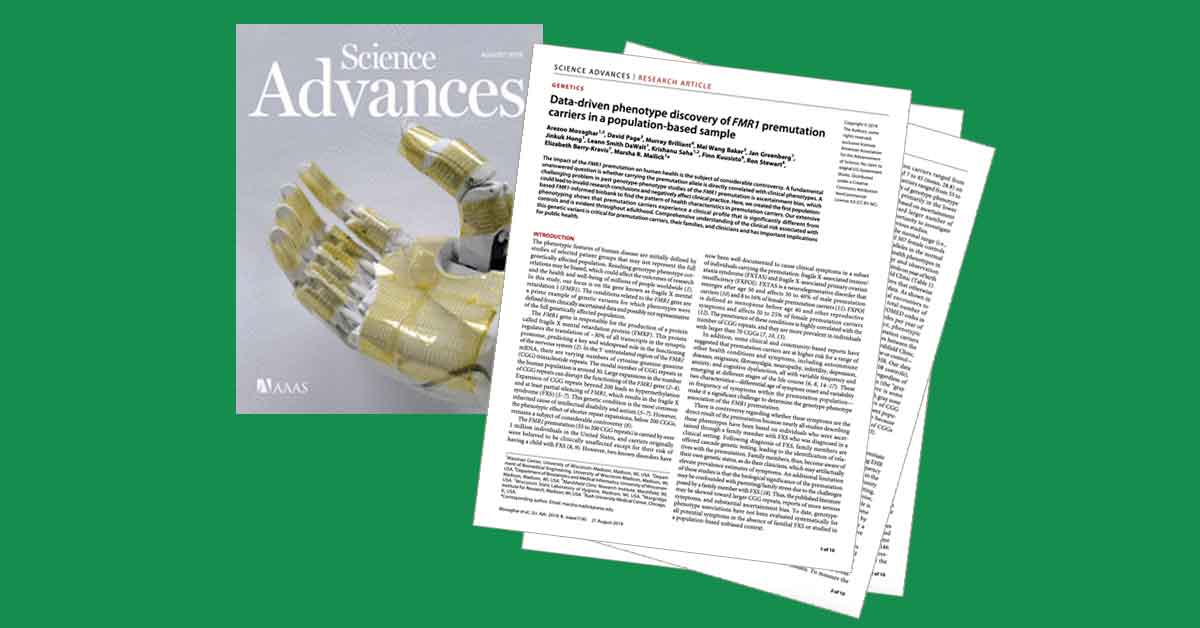
Researchers led by Marsha Mailick, PhD at the University of Wisconsin-Madison, used data from 20,000 electronic health records over 40 years to document health risks of being a premutation carrier. The advantage of this study, “Data-Driven Phenotype Discovery of FMR1 Premutation Carriers in a Population-Based Sample” is that both the patients and the physicians were not aware of the patient’s carrier status, so that didn’t bias the results. As the announcement notes,
A primary goal of the new study, according to Mailick, was to use electronic health records to set up a double-blind methodology — where both clinicians and patients were blind to genotype — to assess whether premutation carriers differed in their patterns of clinical diagnoses from those lacking the premutation.The question is an important one as some clinical reports have suggested that premutation carriers were at greater risk for a wide range of health conditions, including autoimmune diseases, migraines, neuropathy, depression, infertility, fibromyalgia, anxiety, and cognitive deficits, all with varying frequencies and emerging at different stages of life.
Such correlations, notes Mailick, are the stuff of biomedical controversy as nearly all of the studies associating those conditions with the premutation were the result of a family member being diagnosed with Fragile X. Following a diagnosis of Fragile X, family members are offered genetic testing leading to the identification of relatives who carry the premutation. Awareness of that genetic status by patients and clinicians can confound prevalence estimates of symptoms. Frequently, carriers’ medical conditions are blamed on the stress of caregiving and having a family member with Fragile X syndrome.
This is important research to move closer to treatments for all effects of the Fragile X mutation. You can read the announcement of the paper and the whole paper is available at Science Advances.
The study was funded by grants from the NIH, a key focus of NFXF advocacy efforts, and the University of Wisconsin’s Waisman Health Center.