
Data Source: FORWARD — The Fragile X Online Registry With Accessible Research Database (2011–2021)
Title: Factors associated with social participation among children with fragile X syndrome
Authors: Maria G. Gonzalez, April D. Summers, Lisa D. Wiggins, Marc A. Schweizer, Angela M. Thompson-Paul, Sarah C. Tinker[1]
Read the article published in Science Direct
Summary
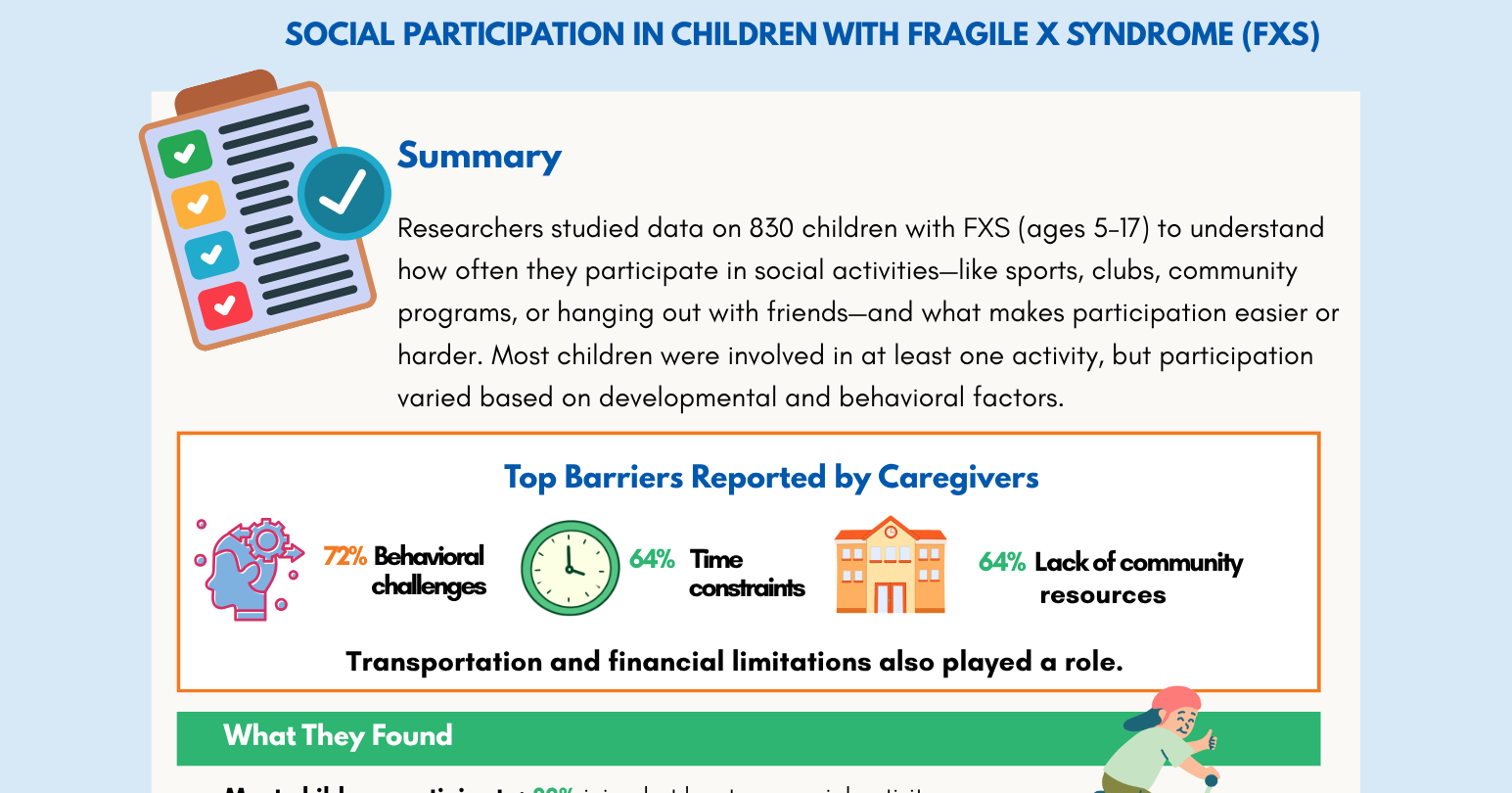
Researchers studied 830 children with Fragile X syndrome (ages 5–17) to understand how often they participate in social activities—like sports, clubs, hanging out with friends, or community programs—and what makes participation easier or harder. Most children were involved in at least one activity, but participation varied based on developmental and behavioral factors.
What They Found
- Most children participate: 82% joined at least one social activity.
- Most common: Physical activities (sports, walking, fitness).
- Least common: Work or volunteer activities.
- Girls participated more broadly than boys across peer, school, and community activities.
- Lower participation was linked to:
- Severe to profound intellectual disability
- Emotional dysregulation (irritability, aggression, agitation, self injury)
Top Barriers Reported by Caregivers
- Behavioral challenges (72%)
- Time constraints (64%)
- Lack of community resources (64%)
- Transportation and financial limitations also played a role.
Why This Matters
- Social participation helps children build independence, confidence, communication skills, and emotional regulation.
- Many barriers are environmental, not child driven—meaning families and communities can make meaningful changes.
- Understanding which children face the biggest challenges helps schools, clinicians, and community programs tailor support.
- These findings may help guide future Fragile X clinical trials toward designs that better support families and children with behavioral concerns.
Next Steps
For Families
- Seek programs with trained staff, smaller groups, or sensory friendly options.
- Explore adapted sports, buddy programs, or community recreation classes.
- Share simple behavior supports with staff to ease participation.
For Schools & Community Programs
- Provide staff training on FXS and emotional regulation.
- Offer flexible, inclusive activities that match a range of abilities.
- Build respite and support options to reduce family time/transportation strain.
For Clinicians & Policymakers
- Expand adaptive programs and community resources.
- Support families with behavioral strategies that make participation easier.
- Strengthen partnerships between clinics, schools, and community organizations.
Acknowledgements & Funding
The present study was supported by cooperative agreements funded by the Centers for Disease Control and Prevention (CDC). Its contents are solely the responsibility of the authors and do not necessarily represent the official views of the CDC or the Department of Health and Human Services.
De-identified data are available according to the FORWARD project’s Data Sharing Plan and the policies of the Centers for Disease Control and Prevention.