




Authors: Hidayat Y. Ogunsola, April D. Summers, Maria G. Gonzalez, Angela M. Thompson-Paul, Marc Schweizer, Robert M. Miller, Hilary Rosselot, Sarah C. Tinker[1]
Read the article published in the American Journal on Intellectual and Developmental Disabilities
Summarized by: Robby Miller, Director, Clinic & International Relations, National Fragile X Foundation
Summary
A group of authors from the U.S. Centers for Disease Control (CDC) and the National Fragile X Foundation (NFXF) reviewed families’ access to one of the NFXF’s Fragile X Clinical & Research Consortium (FXCRC) member clinics.
The authors found that approximately 76% of the U.S. population in the lower 48 states lives in a state that has at least one FXCRC clinic. Specifically, 36% live within one hour of the nearest FXCRC clinic in the same state; 32% live one to four hours away, 7% live more than four hours away, and 24% have no FXCRC clinic in their state.
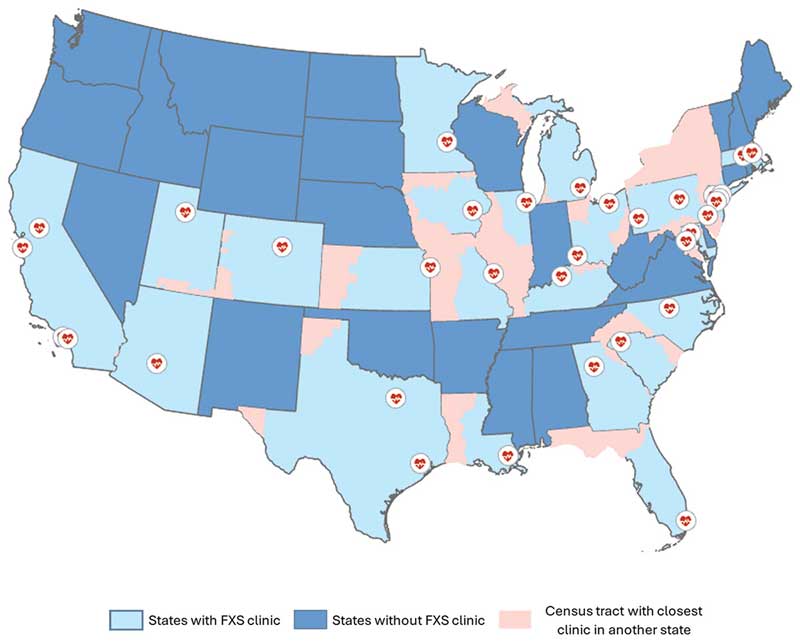
As noted in the article, people living more than an hour from a clinic, or in a state without a clinic, compared to those living within an hour, were more likely to be non-Hispanic white, have a household income below 150% of the poverty line, have one or more disabilities, and live in a household without internet access.
The article also addresses issues related to the provision of cross-state or interstate services, including challenges related to primary language, insurance, and barriers to providing telehealth services across state lines.
The idea for this paper was conceived at the NFXF’s 2024 International Fragile X Conference, where the CDC team was inspired by hearing from families and their providers about their challenges accessing specialty FX care. At the NFXF’s 2026 International Fragile X Conference, the CDC presented the results of their study and noted the important public health implications of their findings, including, “Lifelong, highly specialized care is often needed to optimally support people with FXS, which FXS specialty clinics are well equipped to provide.”
The NFXF appreciates the CDC’s vision for how geographically based data could improve patients’ and families’ access to treatment and help the NFXF address gaps through the FXCRC.
Why This Matters
The above findings can be used to identify areas where there is the greatest need to improve access to specialized Fragile X care. In some instances, doing so can involve identifying existing specialists and services and sharing that information with the Fragile X community. In other instances, it can involve identifying early-career treatment professionals who are interested in learning more about Fragile X and becoming treatment specialists themselves.
Next Steps
The NFXF will continue to identify and contact medical, therapeutic, and counseling professionals at medical centers throughout the U.S. to determine whether they already see Fragile X patients and, if so, would be interested in joining the FXCRC. This could increase referrals to their site through the NFXF’s online “Clinic Finder” tool while ensuring that treatment professionals at that site have access to the most up-to-date, evidence-based knowledge.