



What is the Fragile X Premutation?
The Fragile X premutation is defined by an FMR1 gene expansion of 55–200 CGG repeats and is associated with known and emerging symptoms and conditions. Medical and mental health professionals are still studying how the premutation affects individuals.
The associated conditions represent a spectrum of health issues that may (or may not) affect individuals with the Fragile X premutation — commonly referred to as “carriers” or “Fragile X carriers.”
The Fragile X premutation has a distinct clinical presentation from the full mutation, Fragile X syndrome (FXS). While FXS is defined by an FMR1 gene expansion of over 200 CGG repeats, the premutation (55-200 CGG repeats) allows the gene to remain active, leading to elevated FMR1 messenger RNA (mRNA) levels. These above-normal mRNA levels can interfere with typical cellular function and are thought to contribute to some of the health conditions and symptoms experienced by premutation carriers.
As we learn more about the Fragile X premutation, certain associated, well-defined conditions have emerged — such as Fragile X-associated tremor/ataxia syndrome (FXTAS) and Fragile X-associated primary ovarian insufficiency (FXPOI). At the same time, research is beginning to identify and better understand other symptoms, symptom clusters, and potential conditions possibly associated with the premutation.
It is important to know that having a Fragile X premutation does not mean an individual will develop any associated conditions, but it may indicate an increased risk for certain associated conditions. Many individuals lead healthy lives with no symptoms.
Associated Conditions & Symptoms
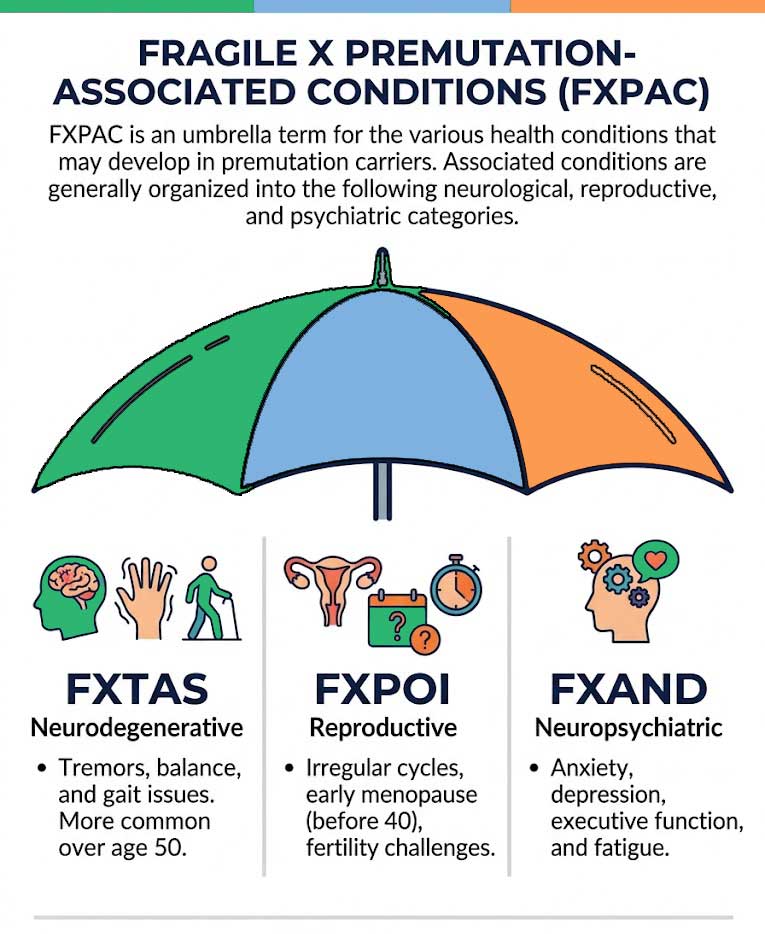
Fragile X Premutation-Associated Conditions (FXPAC)
FXPAC is an umbrella term for the various health conditions that may develop in premutation carriers. Associated conditions are generally organized into the following neurological, reproductive, and psychiatric categories.
1. Fragile X-Associated Tremor/Ataxia Syndrome (FXTAS)
FXTAS is an adult-onset neurodegenerative disorder, more common in males than females over 50 with the Fragile X premutation. FXTAS is associated with tremors, balance and gait problems, and other neurological signs. FXTAS progresses at varying rates in different individuals. A person’s risk of developing FXTAS depends on CGG repeat size, sex, and age.
Key Symptoms
- Intention Tremor: Shaking that occurs during voluntary movement (such as reaching for a cup).
- Ataxia: Loss of balance, unsteady gait, and incoordination.
- Cognitive Decline: Executive function deficits, memory loss, and sometimes dementia.
- Neuropathology: Often associated with “white matter disease” in the middle cerebellar peduncles, visible on MRI.
2. Fragile X-Associated Primary Ovarian Insufficiency (FXPOI)
FXPOI is a condition in which the ovaries of an individual with the FMR1 premutation do not function at full capacity. It can cause infertility, early menopause, and other ovarian and reproductive issues. FXPOI occurs in about 20% of women with the FMR1 premutation.
Key Clinical Features
- Early Menopause: Menopause occurring before age 40.
- Cycle Irregularities: Periods that become infrequent or stop entirely.
- Fertility Challenges: Difficulty conceiving due to reduced ovarian reserve.
3. Fragile X-Associated Neuropsychiatric Disorders (FXAND)
FXAND is a more recent term proposed to group similar disorders possibly experienced by an individual with the Fragile X premutation. It recognizes that many individuals with the premutation may experience psychiatric and cognitive symptoms, outside of any symptoms associated with FXTAS and FXPOI.
Common Manifestations
- Anxiety Disorders: Social and generalized anxiety are highly prevalent in those with the premutation.
- Depression: Frequently reported as a primary concern.
- Executive Dysfunction: Difficulties with planning, organization, cognitive flexibility, and impulse control.
- Isolation: A tendency to withdraw socially, which can exacerbate mood disorders.
Community & Clinical Terminology
As research expands our understanding of the Fragile X premutation, terminology has evolved.
FXAND was proposed as an umbrella term for neuropsychiatric disorders observed in some premutation carriers, while FXPAC was later proposed as a broader umbrella term for all premutation-associated conditions. The use and scope of these terms continue to evolve and are not interchangeable with specific diagnoses such as FXTAS or FXPOI.
Recent publications acknowledge limitations in current research, including limited population-level data and variations by methodology. See:
Insight and Recommendations for Fragile X-Premutation-Associated Conditions from the Fifth International Conference on FMR1 Premutation
Also see our summary of this research.
Finding General, Specialty & Multidisciplinary Care
Finding good quality healthcare can be a challenge. Partnering with a trusted provider will help you identify and evaluate symptoms. On your healthcare journey, you may encounter symptoms or conditions that may or may not be associated with the Fragile X premutation; what matters most is getting the care you need. While it’s always OK to tell a doctor “I have the Fragile X premutation,” it often works much better to start with “I am experiencing anxiety and executive function issues.”
For symptoms and conditions associated with the premutation, Fragile X specialty clinics may be an excellent resource. Clinics currently specialize in Fragile X syndrome and FXTAS, and beginning in 2026, the NFXF is also organizing an FXPOI network of specialists.
- Locate a Fragile X Syndrome Clinic
- Locate a FXTAS Clinic
- Locate a FXPOI Care Provider — Coming Soon
- Locate an International Clinic or Support Network
Management of any Fragile X-associated condition usually requires a team-based approach. This may include neurologists (for FXTAS), reproductive endocrinologists (for FXPOI), and psychiatrists or psychologists (for FXAND). You may also be referred to other specialists for symptoms unrelated to Fragile X. For example, you might be sent to a cardiologist for any heart problems. Do not expect your neurologist to treat these symptoms.
In the end, you may have a primary care provider, a Fragile X specialist, and other specialty care providers. This is typical. The goal for all parties is to work together to support your optimal health.
Focus on Symptoms
You’ve probably noticed there isn’t a clinical consortium for the Fragile X premutation in general. The best way to obtain care for any symptom experienced by someone with the Fragile X premutation is to share and focus on the symptoms. While disclosing your Fragile X status may be helpful, obtaining treatment for symptoms you are experiencing may or may not be impacted due to your Fragile X carrier status.
When talking with your provider, they may not be familiar with all the terminology used within the Fragile X community or in Fragile X research. If you use a term such as FXAND or FXPAC, also describe the specific symptoms or concerns you are experiencing.
Your doctors may need a different approach and some education about Fragile X, though that shouldn’t be the focus of your visit. Focusing on your symptoms will help you find the best care.
Patient Worksheets
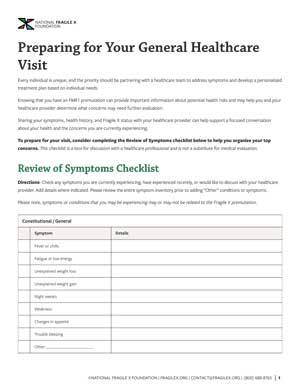
We created worksheets to help you capture and describe any and all of your symptoms. It’s important to remember your current symptoms or conditions may or may not be related to your Fragile X carrier status. Use this at your next doctor’s appointment to help you secure the care you need.

Preparing for Your Healthcare Visit
From our research and conversations with community members, medical records and scans are a pain point for both patients and providers. Without access to these records at the time of your visit, you may need an additional follow-up visit or face delays in recommendations.
This matters for any healthcare visit, but we want to highlight it for anyone who doesn’t yet realize the need to make their records accessible.
Before Your Visit
Be sure to bring any requested copies of previous imaging (MRI, CT scan, X-ray, ultrasound), a list of medications, supplements, over-the-counter medications or products, and other relevant medical records. You may also ask your provider’s office about how to have your medical records or imaging records sent directly to the office.
During Your Visit
Use your worksheet to help organize your priorities for the visit. Many healthcare appointments are brief, so to make the most of your time, focus on the symptoms that brought you in today. Before leaving, make sure you understand any next steps, referrals, or suggestions from the provider.
After Your Visit
Many medical systems now follow up visits with a text or email with a link to your online medical records. Review any notes the medical provider made to ensure they accurately reflect what you communicated during the visit. This is especially important if your provider is not a Fragile X expert or is not very familiar with the Fragile X premutation.
A registry of adults with the Fragile X premutation and their family members without a Fragile X mutation to facilitate research that could improve your quality of life.