


Authors: Vivian Chen, Marisa Vomvos, Anna De Sonia, Hilary Rosselot, Reymundo Lozano
Read the article published in Frontiers Molecular Neuroscience Journal
Summarized by: Vivian Chen
Summary
Gene therapy is being studied as a possible treatment for Fragile X syndrome (FXS). Instead of only treating symptoms, the goal is to address the underlying cause of FXS. Before this type of treatment is tested in people, researchers felt it was essential to hear from the people who matter most: families and members of the Fragile X community. What are your hopes? What worries you? Those answers matter just as much as the science.
The researchers conducted two surveys. The first survey included 351 members of the Fragile X community, and the second included 56 parents and caregivers. What came back was so encouraging: almost everyone was interested! In the community survey, 94% said they would consider exploring gene therapy. Among caregivers, 84% told us they felt hopeful it could succeed, and the same share said they would consider it if it became available. When we asked why, the answer was clear and familiar — above all, families are hoping for a better quality of life for their loved ones.
One exploratory finding stood out. Caregivers of younger people with FXS tended to be more hopeful and more willing to consider gene therapy than caregivers of older individuals. That difference perhaps makes sense: when a child is young, earlier treatment can feel like a wider door — more chances to support development while so much is still unfolding. Caregivers who have walked this path longer may hold a bit more caution, having had years to settle into the treatments and expectations they already know. And across the board, families were thoughtful about the risks, too — the hope is real, but so is the care behind it.
Why This Matters
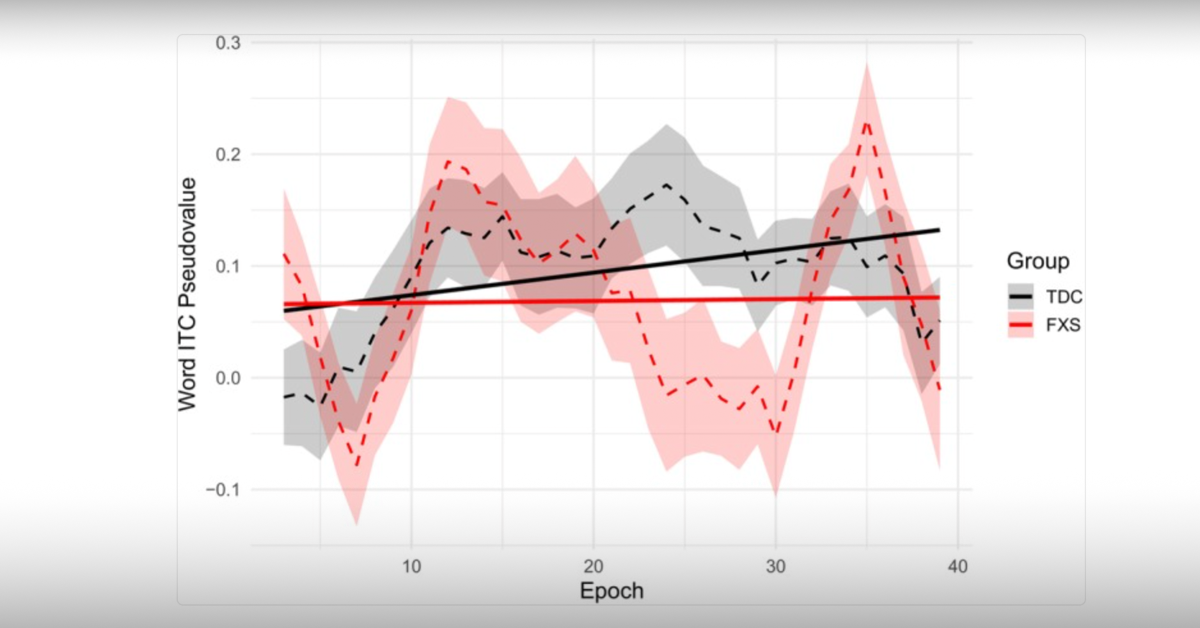
Language difficulty is among the most defining and most stubborn features of Fragile X syndrome, and this study points to one of its earliest roots. Statistical learning is not only about noticing words. It is a general engine for finding and predicting patterns as they stream past, the same rapid machinery the brain uses to anticipate what comes next not only in sound and speech but in what we see and how we move.
What this study makes clear is that the interest is there and it is very high: many families are eager to learn more. But that interest comes with an honest request — they want to understand the risks first. And they want to know the answers to questions like: could this help my loved one’s neurodevelopment? their independence? their day-to-day quality of life? Those are the outcomes families care about. In addition, parents would like to analyze the potential benefits against the risks of an experimental treatment. Because FXS is not usually life-threatening, this is an important and complex decision. This information can help researchers choose outcomes for future clinical trials that are meaningful to families
Beyond describing the voices of the parents and other members of the FXS-community, this article does something just as important: it puts the need on the record. It documents, in the community’s own words, how much families want new options for FXS — and how strong the interest in gene therapy truly is. That evidence matters. When advocacy organizations, pharmaceutical companies, foundations, and other partners can see clear, concrete proof that families are ready and hopeful, it strengthens the case for investment. Our aim is that these findings help encourage the groups with the resources to act — to fund the research, to move promising gene therapies forward, and to bring meaningful treatments for FXS closer to the families who are waiting for them.
Next Steps
There’s a lot to think through. Researchers will need to decide who might be able to take part, which outcomes are the right ones to measure, and how safety should be watched closely both during treatment and long after. And families will need clear, honest information about the possible benefits and risks so they can decide, on their own terms, whether joining a trial feels right for them.
These surveys, as valuable as they are, don’t capture every person and every family touched by FXS. Our community is wide and diverse, and there are voices we haven’t heard yet. As this research moves forward, reaching a broader range of families won’t just make the voice stronger — it will help make sure that whatever comes next truly reflects the whole FXS- community.